
MYSTERY SCENE MAGAZINE

MICHAEL LISTER by John B. Valeri

If writers are grown in the soil of their native lands, then Michael Lister’s roots are firmly planted in North Florida—a fertile ground that has now fortified him for 25 years as the acclaimed author of the John Jordan “Blood” mysteries.

“I can’t remember a time when story wasn’t a huge part of my life,” Lister says. “Of course, it’s a part of everyone’s life, but there’s something about the Southern storytelling tradition that infuses the lives of all those of us who grow up here in the South.”

The son of a second-grade schoolteacher (his mother) and a local business proprietor (of a generations-owned hardware store, his father), he found no lack of inspiration.

“We were surrounded by great storytellers—colorful characters who always had a yarn to spin,” Lister recalls. “I got to listen to those tales day in and day out for my entire childhood. I’ve seen the quote ‘I am a reader moved to emulation’ attributed to many writers, so I don’t know who said it originally, but it’s exactly how I feel. It was my love for story and reading—and what reading and story did for me—that made me want to be a novelist.”

But not just any novelist. As his early reading tastes would suggest, he wanted to explore the world of crime and its ripple effects on humanity.

“I can remember reading the Hardy Boys as a kid,” he says, “and Agatha Christie as a teenager and in college. When I came upon the Spenser novels of Robert B. Parker, the Dave Robicheaux novels of James Lee Burke, and the Father Brown stories of G.K. Chesterton, I knew I wanted to write mystery novels.”

Of course, more practical concerns came first, resulting in an impressively eclectic résumé. Lister taught at both the high school and college levels, was an inspirational speaker, owned a bookstore, wrote for and edited newspapers, operated a community theater, and worked for a production company—all the while penning plays and screenplays.

He also became the youngest prison chaplain in the state of Florida—a position he held for nearly a decade, and one that greatly informed what would become his debut novel, 1997’s Power in the Blood.

“Part of the reason I took the job…with the Florida Department of Corrections was because I was already developing ex-cop, prison chaplain detective John Jordan,” he confesses. “I wanted my detective to have an interesting career in law enforcement and outside of law enforcement, and I wanted his job to bring him in contact with not only many crimes but many people in need and opportunities to serve them by using his gifts.”

And while men of the cloth have often been mainstays in the mystery genre—Lister points to Father Brown as the most famous example—there had never been a prison chaplain detective before.

“I thought that would make for an interesting series,” the author says. “In many ways, John Jordan’s journey, his worldview, his intellect, his spirituality, and his nature make him an outsider. I created a chaplain who was not comfortable with nor engaged in organized religion and an investigator who never fit comfortably inside any law enforcement agency.”

Lister continues, “But I never wanted John to just be a prison chaplain. He was always a detective first.” Consequently, he had Jordan return to law enforcement full-time as a sheriff’s investigator after serving a frustrating stint as a prison chaplain and a detective. “[He] looks for opportunities to help people outside of the context of chaplaincy. John’s faith and spirituality have always been more part of the social justice and counselor/social worker tradition.”

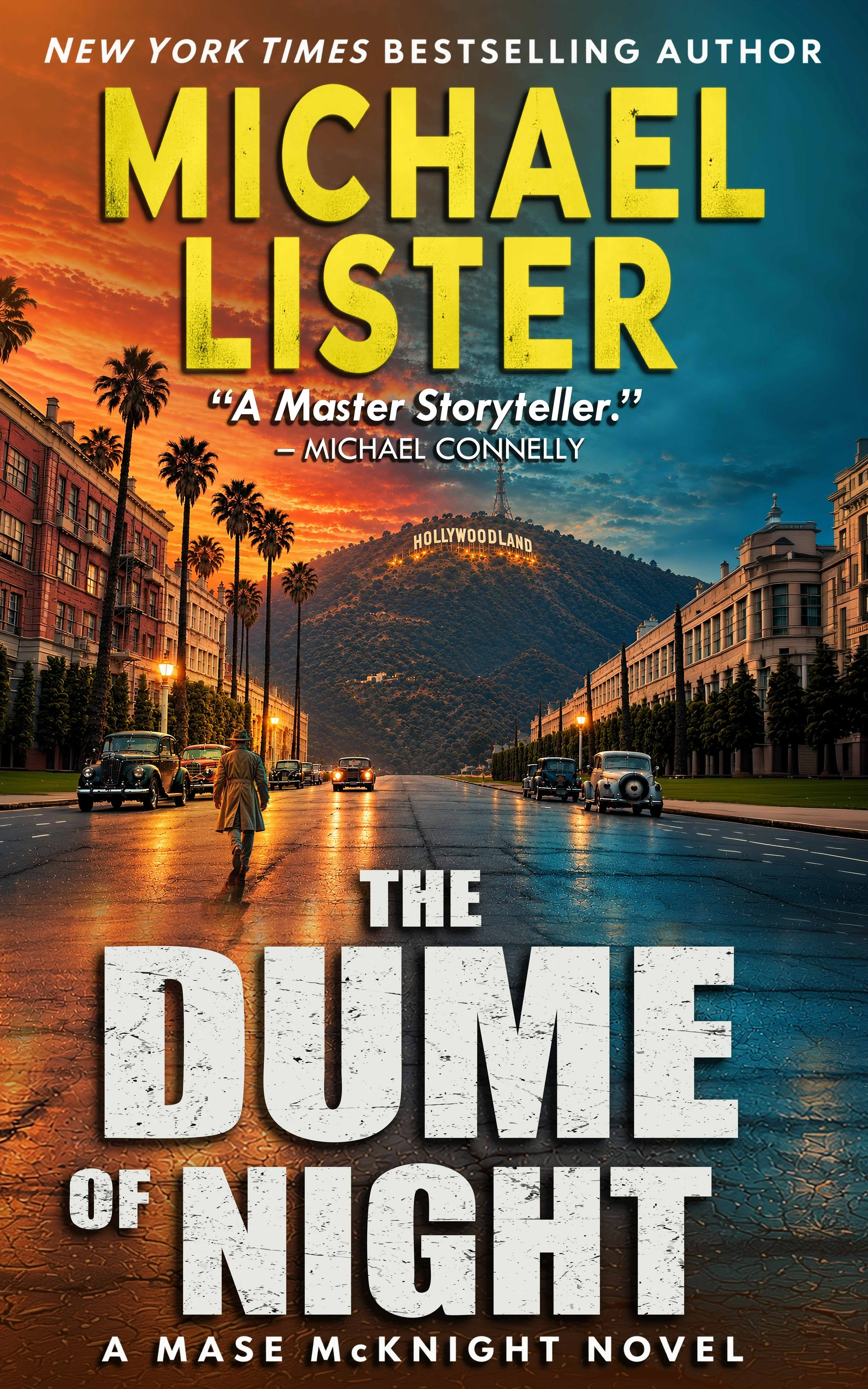
It’s a set-up that has not only caught on with the reading public but also with his crime-writing contemporaries—which has allowed Lister to devote himself fully to his craft. (As evidence: Michael Connelly recently said, “Michael Lister has become a master storyteller in his first 25 years, and he’s only getting started.”)

“I wanted to be a full-time novelist before my first novel came out, so I knew I would take the very first opportunity I had to make that leap. I had such a strong desire to do it that I didn’t spend a lot of time weighing the risks. I just went for it,” the author—who initially supplemented his income by writing a syndicated column and the occasional script—says. “It’s such a gift, such a dream. I am paid to do work I’d pay to be able to do.”

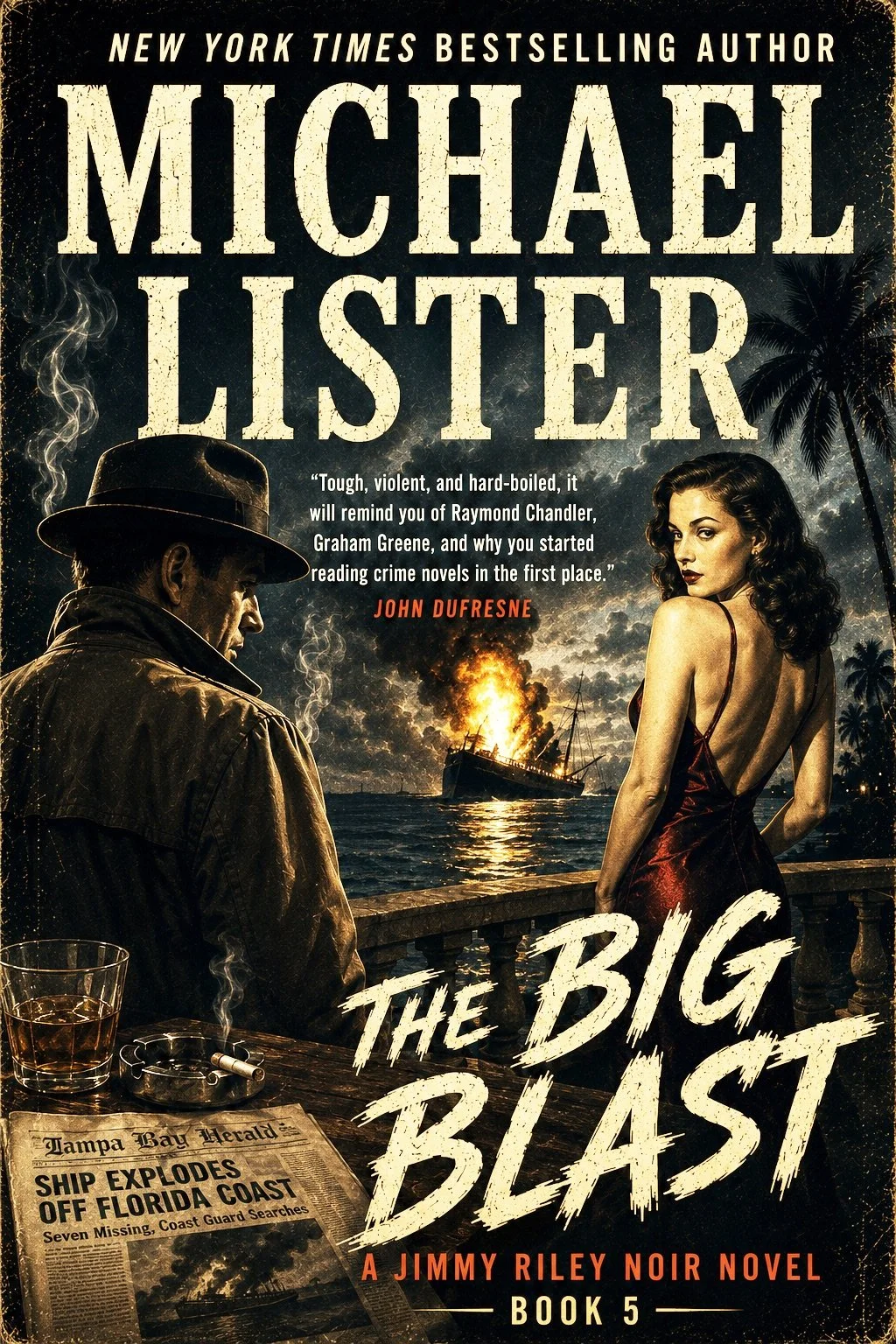
Lister—whose name has appeared on both the New York Times and USA Today bestseller lists, and who has received two Florida Book Awards—has expanded his creative canvas since those early days. In addition to the John Jordan novels, he also writes the Burke and Blade Panama City Beach PI saga and the 1940s Jimmy Riley noir series, as well as thrillers including Double Exposure, Burnt Offerings, and Separation Anxiety.

But John Jordan remains at the forefront of his mind. The series now tallies 29 entries (including two Christmas novellas)—more than one book a year.

In his latest, Blood Reckoning, we find Lister’s protagonist grappling with a tragedy that hits close to home—and one that’s compounded by the lingering effects of last year’s Out for Blood, in which personal and professional upheavals left him reeling.

“John is still grieving the loss of a dear friend when a young woman who has been like a daughter to him goes missing. He needs more time to heal, but he’s not going to get it,” the author says. “John is confronted with his limitations when it comes to helping people. Carla is…someone he has helped for a very long time, and yet when she disappears, he discovers aspects of her life that he knew nothing about.”

The woman in question, Carla Pearson (first introduced in the series’ second book, Blood of the Lamb), was last seen in a water-access-only river camp cabin by her boyfriend, who claims to have left her there following a fight. It’s a locale that further stymies the investigation.

“North Florida river swamps often feature prominently in my books. These are wild, dangerous, yet beautiful jungle-like places,” Lister says. “People can get lost in them and never be seen again. They are also the perfect places for crimes and for hiding bodies.”

This landscape—along with a core cast of characters—has served as a unifying factor throughout the books, which otherwise differ by crime and criminals.

“North Florida is unique and worthy of exploration. I like for setting to inform character and plot and for it to be a character in the novel,” the author says. “I feel like when most people picture Florida, they think about Central Florida and theme parks or the international vibe of South Florida, but few by comparison have experienced the beautiful and wild area I call home. I live in a rural land surrounded by lakes and rivers and swamps, in a region that is in many ways unexplored, undiscovered,” says Lister.

It’s a vast and varied area that Lister is happy to traverse along with readers, whether they’re already familiar with the territory or taking the journey for the very first time—a prospect that also applies to the vista of the books themselves, which can be experienced singularly or as a collective whole.

“Every John Jordan mystery is a complete mystery within a single book. Though most readers like to start from the beginning and read through in order, I write them so a new reader can pick up any title in the series and start with that one,” he says. “My hope is that any questions raised about the characters and their pasts will send readers back to earlier books in the series, but I try to write them in such a way that each one can be enjoyed without this being necessary.”

The small screen might also serve as a possible introductory point, as the novels are currently in development as a potential TV series (while Double Exposure has been optioned for film). Regardless of John Jordan’s fate beyond the page, Lister has no plans to abandon long-form fiction. After all, that’s where he’s discovered as much about himself as he has about his characters.

“Writing has taught me so many things about life and about how to live,” he says. “Life is my teacher. And I learn far more by processing and reflecting on life through writing than I would otherwise. Life is the inspiration and raw material for my writing.”

Consequently, he credits his craft with the ability to be fully present in the world—“I am trying to soak up every facet of every experience not only to get the most out of them, but also to better be able to write about them”—and to make sense of it.

“After nearly 30 years of writing and 25 years of being a published author, I am as interested in and passionate about novel writing today as I have ever been. It is such a part of my identity and purpose that I can’t imagine ever not doing it,” Lister says. “I have attempted to keep my writing fresh and relevant and engaging throughout the course of my career in many ways. I think a lot of it comes down to lifestyle and a certain way of being in the world, remaining open and questioning and reflective.”

Which just goes to show that growth is both possible and sustaining, no matter how many years lived—or stories told.

John B. Valeri is a reader, writer, and reviewer of crime fiction and host of Central Booking. He lives in Connecticut and can be found online at www.johnbvaleri.com.


TALLAHASSEE MAGAZINE

BLOODY WORK IF YOU CAN GET IT

Wynn Parks

Michael Lister is not just a writer; he’s an enterprise! This Wewahitchka boy’s milieu, as a mystery-crime novelist in Northwest Florida, features the folks next door, characters from beach to bayou to piney woods.

Over the past 25 years, Lister has created two series of crime novels and recently has undertaken a third.

But wait, there’s more: a “Meanings” series of his own reflections on life, plus — fingers crossed — Lister has optioned the film script for his book Double Exposure to writer-director Jason Hreno. Lister also heads Michael Lister Charities and, if one cares to look, can be viewed performing original songs on YouTube.

Lister was born in Tallahassee in 1968 to a mom who taught grade school and a dad who was an entrepreneur and owned a hardware store. He grew up playing Little League baseball, but in high school switched to basketball.

“I’m only 6 feet tall, but I still get down on the court with my kids and grandkids,” he said. “I’ve got a killer mid-range jump shot!”

After high school, Lister earned two degrees in theology, instinctively specializing in myth and narrative, and served for a decade as a prison chaplain. Then, in 2000, he departed ministering and took up writing.

If Michael Lister books were films, they’d lean toward docudrama. His “Blood” series of 28 novels (Power in the Blood, Blood of the Lamb, et al.) seems to reflect Lister’s sojourn spent spiritualizing with inmates at three different state prisons.

Whether his fascination with dark tales from the American criminal justice system was induced by those 10 clerical years or his fascination with the works of Dashiell Hammett and Raymond Chandler, cold cases and serial killers inhabit his “Blood” fiction world, presented through the eyes of John Jordon, a kind of Gulf Coast “Father Brown.”

The prolific Michael Lister developed a love for language and Southern storytelling at a young age. Before becoming a full-time novelist in 2000, he taught high school, worked as a college professor and inspirational speaker, owned and operated a bookstore, wrote a popular syndicated column, served as a newspaper editor, operated a community theater, wrote plays and screenplays, and worked for a production company. Photo by Mike Fender

Blood Work, the 12th book in the “Blood” series, opens with a prologue that traces serial killer Ted Bundy’s rampage through Florida from 1978 until 1989, when he was executed in Florida’s electric chair.

In Blood Work, some 40 years after Bundy’s murder spree, the reader encounters John Jordon, the chaplain for the Gulf Correctional Institution and consultant-investigator for the Gulf County Sheriff’s Department, in bed with Anna, his lady love.

A phone call interrupts the couple’s precious spiritual rites with a plea from a local publican — one to which Jordon reluctantly responds and which takes him to a local watering hole where he removes his drunken brother Jake from the premises.

Out of work since his father, “Sheriff Jack,” lost re-election, Jake has become his dad’s keeper-in-misery. Jack is haunted by the disappearance, on his watch, of a local high-school belle, Janet Leigh Lester, who’d gone missing on her prom night. No body was found, only blood scattered on the inside of her car. At the time, because of a contemporary string of murders from Tallahassee to Pensacola and the girl’s victim profile, Sheriff Jack had concluded that Janet Leigh Lester met with foul play at the hands of one Ted Bundy.

Years later, the unresolved case still hangs like a dark cloud over the whole community, while protagonist John Jordon witnesses his father lost in an empty retirement, agonizing over whether his conclusion about Janet Leigh Lester’s fate had been too easy.

The old man’s sense of failure over time has led him to alcohol, and his relationship with his sons, John and Jake, has grown problematic. Thereby hangs not only a murder mystery, but the tale of how John Jordon, special investigator and dutiful son, revives the cold case of Janet Leigh Lester’s disappearance and comes to the aid of a father from whom he’s become estranged.

Essentially, Lister’s Blood Work is a tale with a Southern touch that unearths old mysteries, reveals generational secrets and that, at its best, reveres the notion of the circle being unbroken between generations.

Lister is unbelievably prolific. The New York Times puts him on its list as a best-selling crime-mystery author. His insights into the criminal psyche are often spot-on. Not exactly what the Beatles had in mind in Paperback Writer. Lister’s already made it there, in spades.


Email MichaelLister@MichaelLister.com for an Application Form.


Michael Lister and Michael Connelly

Discuss Writing Long-Running Series Mysteries


NEW BOOK ANNOUNCEMENT!

The thrilling new Burke and Blade mystery!

Order your copy of DAY AND NIGHT today!

Was Harper Ellis murdered or was it suicide?

Harper Ellis had everything to live for—a promising career as a beloved elementary school teacher, a tight-knit group of friends, and a dream wedding on the horizon with her fiancé, Daniel Kessler. Life in her beachfront condo in Panama City Beach, Florida, should have been the start of her happily ever after. But on the evening of January 26, 2021, Harper was found dead—brutally stabbed twenty times in her own home.

Daniel swears he left her alive just thirty minutes earlier. When he returned, the condo was locked from the inside, the security bar engaged. His frantic messages went unanswered, his texts turning from confusion to fury. For an hour, he called, he threatened, he begged. And when he finally forced his way inside, Harper was gone.

What happened in that locked condo? Investigator Lucas Burke is determined to find out. And this time he has to do so without his partner in crime, Alix Blade.

The authorities ruled it a suicide—despite a crime scene that told another story. A knife still embedded in her body. Deep, violent stab wounds, some to her spine and neck. Bruises in different stages of healing. A trail of forensic inconsistencies, overlooked or dismissed. A fiancé whose alibi unraveled under scrutiny. And a police department under pressure to close the case.

But the truth won’t stay buried.

As Harper’s sister hires Burke to fights for justice, shocking details emerge—secrets hidden beneath the surface of a perfect life. Was Harper a victim of intimate partner violence ignored until it was too late? Or did someone else have reason to want her silenced? And if this was murder, how did the killer escape a locked room?

In the vein of Gone Girl and The Girl on the Train, Day and Night is a gripping psychological thriller that will keep you questioning every twist until the final, chilling revelation.


JOHN JORDAN IS BACK!